
Startups burn through capital fast, and choosing the wrong business premises accelerates the problem. Sign a three-year lease for space you can’t afford, and you’re trapped. Underestimate infrastructure needs, and you’re paying rent for unusable space. Overcommit on square footage, and you’re funding empty desks while your runway shrinks.
This guide provides a systematic framework for evaluating space for business lease: calculate requirements, decode costs, match location to operations, and assess lease terms against your financial reality. The process prevents expensive mistakes that drain resources before your business gains traction.
Quick Reference: Space Selection Criteria
Before touring any company premises, evaluate these critical factors:
- Actual operational requirements vs. aspirational aesthetics
- Total cost structure: upfront + monthly + hidden fees
- Lease flexibility aligned with financial runway
- Location functionality for your specific business model
- Infrastructure readiness: internet, power, access, security
Step 1: Calculate Your Actual Space Requirements
Most startups guess wrong. They either overestimate based on growth fantasies or underestimate by forgetting non-desk requirements like storage, meeting areas, and equipment zones.
Use this calculation framework:
Total Square Footage = (Employees × Sq Ft per Person) + Equipment/Storage + Meeting/Client Space.
Let’s take examples for a few business types:
SaaS Startup (5 people, minimal equipment):
- 5 employees × 100 sq ft = 500 sq ft
- Equipment/server space = 50 sq ft
- Small meeting area = 100 sq ft
- Total: 650 sq ft minimum
Product-Based Business (3 people, inventory):
- 3 employees × 120 sq ft = 360 sq ft
- Inventory/packing area = 200 sq ft
- Shipping/receiving zone = 100 sq ft
- Total: 660 sq ft minimum
Service/Consulting Firm (4 people, client meetings):
- 4 employees × 100 sq ft = 400 sq ft
- Client meeting room = 150 sq ft
- Reception/waiting area = 100 sq ft
- Total: 650 sq ft minimum
The common mistake appears when founders add aspirational growth. Signing for 1,200 square feet because “we’ll hire three more people in six months” means paying for 550 square feet of empty space if those hires don’t materialize—potentially $500-$800 monthly wasted.
Red flag: If you’re planning to “grow into” the space within six months, you’re gambling rent payments on unproven projections. Start smaller. Facilities offering internal expansion options let you scale without relocating.
Step 2: Decode the Real Cost Structure
Base rent tells only part of the story. Traditional leases hide costs in CAM charges, utility bills, and buildout requirements that easily double your monthly commitment.
Compare three common pricing models:
| Cost Component | Traditional Office Lease | Private Studios/Coworking | Shared Office Suites |
|---|---|---|---|
| Base Rent | $1,200/month | $1,000/month | $900/month |
| Security Deposit | $3,600 (3 months) | $1,000 (1 month) | $1,800 (2 months) |
| CAM/Utilities | $200-400/month (variable) | Included | $100-200/month |
| Internet Installation | $500-2,000 upfront | Included | $300-800 upfront |
| Furniture/Buildout | $5,000-20,000 | Turnkey/included | Partially furnished |
| Cleaning/Maintenance | $150-300/month | Included | Shared/included |
| First Month Total | $10,650-26,900 | $2,000 | $3,500-5,000 |
| Monthly Ongoing | $1,550-1,900 | $1,000 | $1,000-1,100 |
Understanding the hidden charges:
CAM (Common Area Maintenance) charges cover hallway lighting, lobby upkeep, shared bathroom cleaning, and parking lot maintenance. These fees range from $3-8 per square foot annually—on a 600 square foot space, that’s $150-400 monthly added to base rent.
Utility setup creates another cost layer. Electric, gas, water, and internet each require deposits and installation fees totaling $800-3,000 before service begins. Even “move-in ready” traditional spaces often need minor improvements, and every month you pay rent during renovations is money spent before you can operate.
Critical evaluation question: Calculate total occupancy cost (rent + deposits + utilities + furniture + maintenance) for the first six months. Can your startup absorb that while generating little to no revenue? If not, all-inclusive pricing protects your runway.
Step 3: Match Location to Your Business Model
Location affects three operational elements: team productivity, client perception, and logistical efficiency. The “best” location depends entirely on which elements matter most for your business.
Scenario 1: Remote-First Team with Occasional In-Person Meetings
Priority: Central location near major transportation hubs. Team members commute infrequently, so proximity to transit matters more than neighborhood prestige. Accept slightly higher rent for flexibility and convenience.
Example: A software startup with two local employees and four remote workers needs meeting space near subway or train stations, not a full-time office in an expensive downtown core.
Scenario 2: Client-Facing Business Serving Local Market
Priority: Accessibility within target neighborhood. Clients value convenience over impressive addresses, and local presence builds community trust. Choose growing creative neighborhoods over premium business districts.
Example: A design consultancy serving small business clients benefits more from accessible parking and comfortable meeting spaces than from a prestigious but inconvenient downtown address.
Scenario 3: Recruiting Specialized Talent
Priority: Proximity to talent sources (universities, industry clusters, residential areas where target employees live). Commute time affects recruitment success significantly. Research where your target hires currently work and live, then choose accordingly.
Example: A data analytics startup recruiting recent graduates might prioritize locations near university campuses over traditional business centers.
Scenario 4: Product-Based Business Requiring Logistics
Priority: Loading dock access, ground-floor options, proximity to shipping carriers. Moving inventory up stairs wastes time, and shipping costs vary significantly by location. Industrial or converted warehouse spaces often provide better logistics at lower cost than office buildings.
Example: An e-commerce startup shipping 50+ packages daily needs ground-floor access and package receiving capabilities, not polished office aesthetics.
Real cost comparison:
A Philadelphia design startup evaluated two options:
- Downtown Class A office: $2,400/month, impressive address, difficult client parking, 45-minute average team commute
- Fishtown creative district studio: $1,200/month, culturally relevant address, street parking available, 20-minute average team commute
They chose Fishtown. After twelve months, the $14,400 rent savings funded a full-time designer hire. Client feedback revealed they preferred the creative neighborhood atmosphere over corporate downtown formality.
Step 4: Evaluate Lease Terms Against Your Runway
Startups typically operate on 12-18 month runways between funding rounds or profitability milestones. Lease commitments extending beyond your financial certainty create substantial risk.
Three-to-five-year traditional leases trap you if business pivots, downsizes, or fails. Early termination penalties often reach 50-100% of remaining rent obligations—breaking a three-year lease after eighteen months might cost $18,000-36,000. These commitments only make sense when you have established revenue, proven business model, and high confidence in location and size requirements.
Month-to-month flexible arrangements provide exit flexibility without penalty but typically cost 10-25% more than longer commitments. You might pay $1,200 monthly versus $1,000 monthly for equivalent space. This premium proves worthwhile when you’re pre-revenue, testing your business model, uncertain about team size, or operating on a limited runway.
One-to-two-year leases with expansion options balance commitment and flexibility. Look for options to extend, expand to adjacent units, or terminate with 60-90 days notice. This approach works well for businesses with early revenue, validated models, and predictable near-term needs.
Questions startups forget to ask before signing:
What happens if we need to downsize? Can you reduce square footage or sublease excess space? Can we sublet if we pivot? What are the specific dollar amounts for early termination penalties? Do expansion options exist within the building? Are rent increases capped in month-to-month arrangements?
Financial runway calculation:
Safe Lease Commitment = (Current Runway Months × 0.5) – 3
Example: 18-month runway → (18 × 0.5) – 3 = 6-month maximum safe commitment
This conservative formula accounts for unexpected expenses and slower-than-projected revenue growth, with a three-month buffer for exit flexibility.
Testing Infrastructure During Site Visits
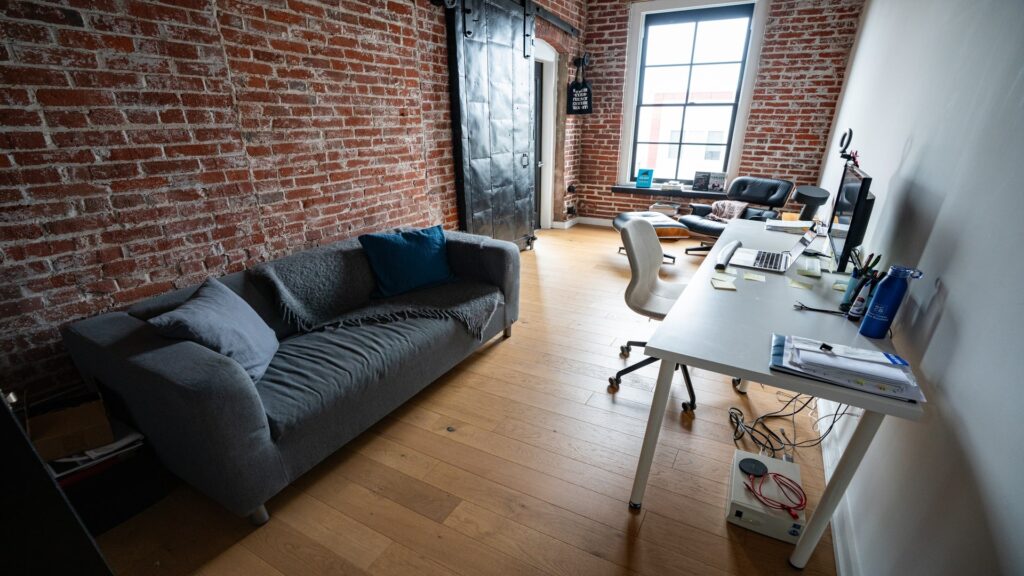
Tour business premises during your actual working hours and personally verify the infrastructure that affects daily operations. Marketing materials describe amenities optimistically; your own testing reveals reality.
Internet performance matters critically for most businesses. Run speed tests during your tour and record actual results. Tech startups need minimum speeds of 100 Mbps download and 20 Mbps upload. Ask about network reliability and whether backup systems exist. Buildings sometimes share bandwidth across all tenants, causing slowdowns during peak hours that wouldn’t show during morning tours.
Power and climate control affect both comfort and equipment functionality. Count electrical outlets in workspace areas—modern businesses run laptops, monitors, phones, printers, and specialized equipment simultaneously. Test the HVAC system: can you adjust temperature individually, or does building-wide control mean you’re stuck with whatever the landlord sets?
Access and security determine whether you can work when you need to. Confirm building access hours explicitly—24/7 or restricted? Understand the after-hours entry process: physical keys, access cards, smartphone apps, or security staff coordination? Observe security measures like cameras, controlled entry systems, and overnight safety conditions.
Parking and transportation directly affect whether team members and clients can reach your location conveniently. Count available parking spaces and compare to your team size plus expected client volume. Measure actual distance to the nearest public transit station. Consider how clients arrive and where they park.
Acoustic privacy influences whether you can work effectively and conduct confidential business. Stand in adjacent spaces during tours and test sound transmission at normal speaking volume. Can you conduct confidential phone calls without being overheard? Are background noise levels acceptable for video calls?
Practical logistics complete the evaluation. How does package receiving work—secure room, front desk acceptance, or packages left unattended? Do loading areas exist for equipment or inventory deliveries? What’s the actual condition of shared amenities like bathrooms, kitchens, and meeting rooms?
Visit twice: once during scheduled tours when everything appears in showcase condition, and once unannounced during peak hours to see daily reality.
Common Mistakes That Cost Startups Money
Learn from these expensive errors:
1. Trading flexibility for marginal savings
- Mistake: Signing 3-year lease to get $200/month discount
- Consequence: Business pivots after 14 months, owes $20,000 early termination penalty
- Better approach: Pay $200/month premium for month-to-month flexibility; save $17,600 on avoided penalty
2. Touring only during ideal conditions
- Mistake: Visiting at 10am Tuesday, discovering later that neighborhood feels unsafe after dark or building inaccessible on weekends
- Consequence: Remote team members won’t visit; evening client meetings impossible
- Better approach: Tour during your actual working hours on different days and times
3. Comparing only base rent numbers
- Mistake: Choosing “$1,000/month” space without asking about CAM, utilities, deposits
- Consequence: First month costs $4,500; monthly ongoing costs reach $1,450
- Better approach: Demand written breakdown of ALL costs before comparing options
4. Underestimating buildout time and cost
- Mistake: Signing lease for “almost ready” space needing “minor updates”
- Consequence: Pay 3 months rent ($3,600) while waiting for permits, construction, inspections
- Better approach: When cash-constrained, choose turnkey spaces; delay moves into buildout-required premises
5. Ignoring growth/contraction options
- Mistake: Signing for exact current needs with no expansion or reduction flexibility
- Consequence: Hire 2 people, need 40% more space, must relocate entirely
- Better approach: Select facilities offering internal expansion; prioritize flexibility over perfect current fit
Find Startup-Friendly Business Premises in Philadelphia
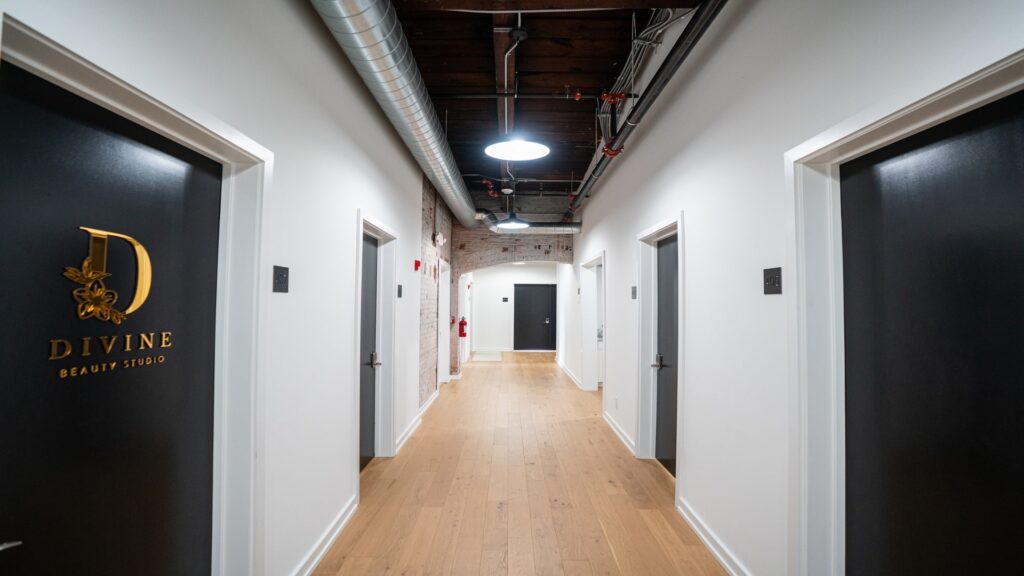
Silk Screen Studios offers 200-600 square foot private units designed for small businesses and startups needing flexible workspace. Month-to-month lease terms eliminate long-term risk, while all-inclusive pricing ($970-$1,300/month) covers rent, utilities, internet, and amenities without hidden charges.
Located at 179 W. Berks St. in Philadelphia’s Fishtown neighborhood, the facility provides 24/7 secure access, individual climate control, package receiving services, and the flexibility to expand internally as your business grows.
Schedule a complimentary tour to evaluate how the space fits your startup’s operational and financial requirements.
FAQ
How much space does a startup actually need per employee?
Budget 100-120 square feet per employee for desk workspace, then add equipment storage, meeting areas, and reception space based on your business type. A 5-person startup typically requires 650-800 square feet total, including all operational zones. Product-based businesses need additional inventory storage; service businesses need client meeting spaces.
What lease terms should startups prioritize when cash flow is uncertain?
Month-to-month or short-term (6-12 month) leases with minimal early termination penalties protect startups with limited runways. Avoid commitments extending beyond half your current runway length. Look for expansion options within the same facility rather than signing for space you’ll “grow into” based on uncertain projections.
Are traditional office leases or flexible space arrangements better for early-stage companies?
Flexible arrangements better serve early-stage companies because they eliminate upfront buildout costs ($5,000-20,000), reduce security deposits (1 month vs. 3 months), include utilities and internet, and provide exit flexibility when business needs change. Traditional leases make sense only when you have established revenue and high confidence in long-term space requirements.
What hidden costs should I budget for when leasing company premises?
Traditional leases include CAM charges ($150-400/month), utility deposits and setup fees ($800-3,000), internet installation ($500-2,000), furniture and equipment ($5,000-15,000), and ongoing maintenance or cleaning ($150-300/month). Calculate total first-month costs and ongoing monthly expenses beyond base rent before comparing options.
How do I know if a location is right without committing long-term?
Tour during your actual working hours, test the commute from where team members live, observe client parking and access, verify internet speeds personally, and visit on different days to assess neighborhood patterns. Start with short-term flexible arrangements (month-to-month or 6-month terms) to test location functionality before committing to multi-year leases.